
Buyer guide
Collapsible Camping Crates: Materials, Sizes and Customization Options
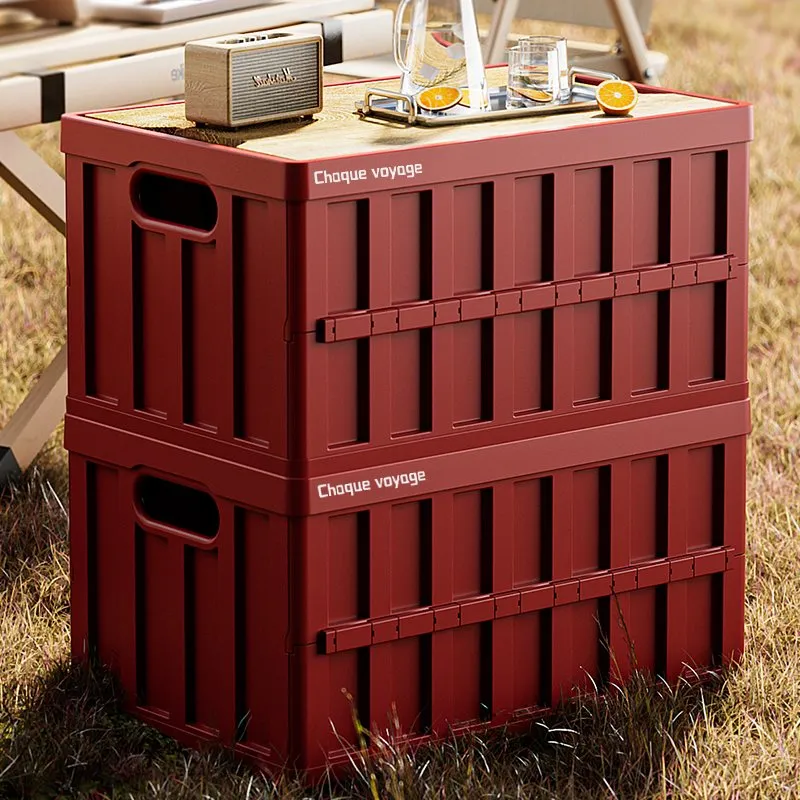
Collapsible camping crates have moved from a niche outdoor accessory to a mainstream product sold by outdoor retailers, car accessory brands, home stores and online sellers. They appeal to end users because they fold flat when empty, stack neatly when full and look good at a campsite, especially with a wood-grain lid that doubles as a small table. For wholesale buyers, the category offers plenty of room to differentiate through color, lid design and branding. This article explains the main material choices, typical size ranges and customization options to consider when buying collapsible camping crates wholesale.
What makes a good camping crate?
A camping crate is used harder than an indoor storage box. It gets loaded with cookware, water bottles and tools, carried across uneven ground, left in the sun and thrown in a car trunk. When you evaluate products, focus on:
- Rigidity when unfolded. Side walls should lock firmly so the crate does not collapse when lifted by its handles.
- Handle comfort and strength. Molded handles should be smooth, wide enough for gloved hands and not flex excessively under load.
- Lid function. Does the lid sit securely? Can it support light items as a tabletop? Is there a side door so users can reach items when crates are stacked?
- Stackability. Full crates should stack without sliding. Look at the lid-to-base interlock.
- Folded thickness. Thinner folded profiles mean more units per carton and lower freight cost per unit.
Materials
Polypropylene (PP) body
Most collapsible crates are injection molded from polypropylene. PP is light, resists many chemicals and moisture, and tolerates the repeated flexing that folding walls and snap features require. Grades vary: some formulations prioritize stiffness, others impact resistance at low temperatures. If your customers camp in cold climates, ask your supplier how the chosen grade performs in cold conditions. For a comparison with polyethylene, see PP vs HDPE: choosing plastic for storage boxes.
UV stability
Outdoor products spend long periods in sunlight. Unprotected plastics can fade and become brittle over time. UV stabilizer additives can slow this down; it is reasonable to ask a supplier whether they are used and to discuss expectations for outdoor exposure.
Lid materials and finishes
Lids are where camping crates differentiate visually. Common options include:
- Plastic lids, molded in the same or a contrasting color. Practical, light and easy to clean.
- Wood-grain lids, which give the "outdoor lifestyle" look popular in campsite photos. Ask what the wood-grain lid is made from and how it handles moisture.
- Combination lids with a side door, which let users open the crate from the front when another crate is stacked on top.
Sizes
There is no industry-standard size for camping crates, but ranges tend to cluster around a few uses:
- Small (carry-handle) crates for snacks, utensils, lanterns and small items, easy to carry with one hand.
- Medium crates for cookware, food and general gear, often the best-selling size.
- Large crates for bulky items like blankets or as trunk organizers.
Many buyers offer two or three sizes from the same design family so that they nest and stack together visually. When choosing sizes, consider your customers' vehicles, typical shelf depth in retail, and how many folded units fit in a standard shipping carton. Always ask the supplier for both external dimensions and folded dimensions.
For reference, our catalog lists folding crates such as the H-80T1 (37.7 × 25.5 × 21 cm, with carry handle), the H-8013 (51.8 × 34.7 × 27.1 cm) and the H-8123 (53.5 × 35 × 36 cm, with side door). Full specifications are on each product page.
Customization options for wholesale buyers
Custom colors
Earth tones such as khaki, olive, sand and gray are common in the outdoor segment, but brands increasingly want signature colors. Custom colors are produced by adding a color masterbatch to the base resin. The supplier will match your reference (a Pantone code or physical sample) and send color samples for approval. Minimum quantities for a custom color depend on the model; ask your supplier.
Logo and branding
Typical options include:
- UV printing on lids or side panels, suitable for full-color logos.
- Laser marking, which gives a permanent, subtle mark.
- Labels and stickers, the most flexible and lowest-commitment option.
- Mold-embossed logos, which require mold modification and are usually considered only for larger long-term programs.
We explain these methods in more detail in OEM plastic storage boxes: custom color and logo explained.
Packaging
Retail buyers often want a printed color box or a branded sleeve; online sellers may prefer simple, protective cartons that meet marketplace packaging rules. Discuss packaging early because it affects carton size, freight cost and lead time.
Accessories and bundles
Some sellers bundle crates with dividers, cushions or carry straps. If accessories come from other suppliers, plan how and where kits will be assembled.
Questions to ask a wholesale supplier
- What material and grade are used for the body and the lid?
- What are the external, internal and folded dimensions?
- What load has the crate been tested with, and how was it tested?
- What is the MOQ for stock colors and for custom colors on this model?
- Which logo methods are available, and what are the costs for each?
- How many pieces fit per carton, and what are carton dimensions and weight?
- Can I approve a pre-production sample in my color?
Next steps
If you are planning a camping crate line, send us your target sizes, colors and branding requirements. Lizhong Plastic is an ISO 9001 certified manufacturer with an 11,500 m² factory and design patents on our own crate designs, and we offer OEM/ODM with custom colors and logos. MOQ, lead time and pricing depend on the model and customization, so ask us and we will quote your specific request. Also see our broader buyer's guide to sourcing folding storage boxes from China.